

When we talk about teaching autistic children life skills, we often focus on the things they need to do for themselves: dressing, brushing their teeth, bathing, using the toilet, eating independently and keeping themselves clean. These skills are important. Every child should be supported to become as independent as possible in taking care of themselves.
But there is another group of skills that we sometimes overlook: the everyday things we do to take care of our homes, families and communities. Your autistic child does not only need to learn how to look after themselves. They can also learn how to participate in everyday family life.
Start with the ordinary things
Think about the things you do around the house every day. Someone has to set the table before supper. Someone has to clear it afterwards. Someone loads electricity tokens when the lights are about to go off. Someone sweeps the veranda, mops the floor, carries laundry, puts clothes away, takes out rubbish or helps arrange things around the house. These may seem like ordinary chores to us, but they are actually opportunities for learning.
Depending on the child’s age and abilities, you can teach them to:
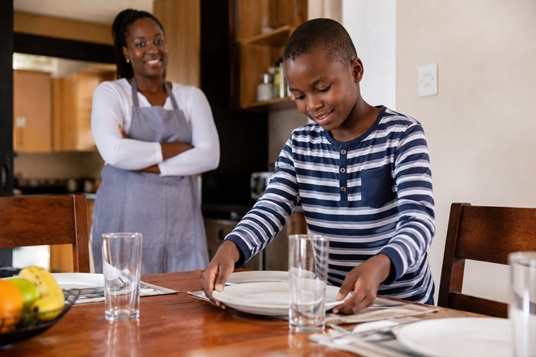
- Set the table for meals.
- Clear plates and cups after eating.
- Carry folded or sorted laundry.
- Put their clothes in the right place.
- Sweep the compound or veranda.
- Mop a small area of the floor.
- Help put groceries away.
- Water plants.
- Help prepare simple parts of a meal.
- Sort household items.
- Help tidy their room or common spaces.
- Put rubbish in the appropriate place.
- Help with simple household routines such as checking whether lights are switched off.
- Participate in age-appropriate household tasks involving technology, such as learning how electricity tokens are loaded, with appropriate supervision.
The goal is not to give a child a long list of chores. It is to communicate an important message:
“You are capable of learning how things work, and you have a place in this family.”
These are also learning opportunities
A simple household chore can involve many different skills.
Sweeping, carrying laundry or helping to mop can provide opportunities to develop gross motor skills, coordination, balance and body awareness. Sorting objects, folding clothes, arranging utensils or handling small household items can support fine motor skills and hand-eye coordination. Following a sequence such as “get the plates → put them on the table → get the spoons → place them beside the plates” can develop planning, sequencing and following instructions. Learning that the electricity token needs to be loaded before the units run out introduces practical concepts such as numbers, technology, time, problem-solving and cause and effect. Even something as simple as putting groceries away can involve categorisation: Where does this belong? What goes in the fridge? What goes in the cupboard?
These are real-life learning opportunities.
It also builds independence
One of the greatest gifts we can give our children is the ability to say:
“I can do this myself.”
Independence is not only about being able to dress yourself or brush your teeth. It is also about knowing how to participate in everyday life. A child who learns early how to set the table, organise their belongings, sweep a room or help with household routines is gradually developing the skills they may need to live more independently as a teenager and adult. For autistic children in particular, teaching these skills early and practising them repeatedly can be valuable. Many everyday tasks involve routines, and routines can provide useful structure and predictability.
Don’t wait until they are teenagers
Sometimes parents understandably think, “He is still young. We will teach him these things when he is older.” But independence is built gradually. A young child may start by carrying their own cup to the table. Later, they can learn to put cups on the table for everyone. Eventually, they might learn to help set the entire table. The same principle applies to laundry, cleaning, cooking, shopping and other household responsibilities.
Start small. Break the task into steps. Demonstrate it. Practise it repeatedly. Give your child enough time to learn. And don’t be afraid to adapt the task. If sweeping the entire compound is too much, start with one small section of the veranda. If folding an entire basket of clothes is overwhelming, start with five towels. The objective is not perfection. It is participation, learning and increasing independence over time.
Let them be part of the family
There is another important reason to teach these skills. Children learn not only how to care for themselves, but also how to contribute to the people around them. When everyone in the household has responsibilities appropriate to their age and abilities, the autistic child should not automatically be excluded from that expectation simply because they are autistic. Of course, their responsibilities may need to be adapted. They may need visual instructions, demonstrations, prompts, extra repetition or more time. Some tasks may need to be modified because of sensory, motor, communication or safety considerations. That’s okay.
Inclusion does not mean expecting every child to do exactly the same thing. It means finding meaningful ways for every child to participate.
Think beyond childhood
As parents, we naturally worry about our children’s future. What happens when they finish school? Can they travel independently? Can they prepare food? Can they manage money? Can they keep their living space clean? Can they participate in a workplace? Can they live with some level of independence? We cannot answer all of those questions when our children are young. But we can start preparing them. Every time your child learns a new practical skill, you are adding another building block to their future independence.
So, yes, teach your autistic child to dress themselves. Teach them to brush their teeth. Teach them to use the toilet independently. But don’t stop there.
Teach them how to set the table. Teach them how to sweep. Teach them how to carry laundry. Teach them how to organise things. Teach them how to contribute to the household. Teach them practical skills that will help them navigate the world. Because the goal isn’t simply to raise a child who can take care of themselves. It is to help raise a person who can participate, contribute, make choices and live as independently as possible.
Sometimes, that journey begins with something as simple as handing them a broom and saying: “Come, let’s do this together.”